Is it worth charging the family market rent at your holiday home?
General information only, not tax advice, and it doesn't take your circumstances into account. It reflects ATO guidance as at November 2026. The couple below is made up and the numbers are rounded for illustration. For advice on your situation, talk to a registered tax agent (check one on the Tax Practitioners Board register) or contact the ATO.
Short answer: for a typical paid-off holiday house, probably not. Charging the family market rent over the holidays can unlock the costs of owning the place, like rates, insurance and repairs, as deductions. But you pay tax on the family's rent, and in our worked example the two roughly cancel out. The sums only swing clearly in favour of charging when there's a loan, because the interest becomes deductible too. And if you're retired on a low taxable income, deductions are worth less to you again.
There's also a big "if". It only works if the ATO accepts the house is mainly rented all year, not just over Christmas. This is part 2 of a three-part series. Part 1, can you claim holiday home expenses if you also use it yourself, explains the rule.
The thread running through all three parts: keep good records and let a registered tax agent make the call. Brevity Bookings keeps the record of who stayed and what they paid as you go. More on that near the end.
Does this apply to me?
Pull up a chair if:
- you own a holiday house as an individual, and the family has it over the holidays
- someone has told you that charging them rent would save your deductions
- you'd like to see the sums before raising it at Christmas lunch
Call a registered tax agent early if:
- the house is owned through a company or trust, or renting it is part of a business
- there's a loan on the place, because the answer swings on the interest
What's the rule we're testing?
Under the ATO's ruling TR 2026/1, a holiday home that isn't used or held mainly to earn rent at all times during the income year loses deductions for owning it: interest, council rates, land tax, repairs and so on (paragraphs 35, 37 and 94). Costs that relate only to renting, such as advertising, booking fees and cleaning after guests, stay deductible to the extent they're incurred to earn rent (paragraph 36).
The peak periods matter most (TR 2026/1, paragraph 112): blocking out Easter, Christmas and the school holidays for family is exactly the ATO's Carla example, where ownership costs are denied (paragraphs 119 and 120).
Rent from family is still rent, even at a discount (TR 2026/1, paragraph 67), and family staying free or below market rent counts as holiday-home use (paragraphs 12 and 121).
Which costs are at stake?
There's no public data on what Australian holiday homes cost to run, so we've built the example from stated assumptions rather than averages. Here's how the ATO sorts the usual bills:
- Named as denied: interest on a loan to buy the place, council rates, land tax, and repairs and maintenance (TR 2026/1, paragraph 94). The ATO's holiday homes page adds water rates, body corporate fees and, in its examples, insurance.
- Probably denied, but not named: power and gas. The ruling denies costs incurred to "use, operate, maintain, or repair" a holiday home, and its list of examples is "not limited to" the ones it names (TR 2026/1, paragraphs 35 and 94). We've treated these as denied.
- Still claimable: costs of renting rather than owning, such as advertising, booking fees and cleaning after a guest stay (TR 2026/1, paragraph 36). Cleaning after you, your family or friends isn't, according to the ATO's holiday homes page.
- Left out of our sums: depreciation and capital works deductions. The ruling says these are outside its scope (TR 2026/1, paragraph 8), so ask your tax agent. Improvements, like a new deck, are capital, not an expense (paragraphs 80 and 81); whether they're claimable over time is that same capital works question. Keep those receipts with the rest: the ATO's page on keeping records for property says to keep your records from purchase to sale, and for at least five years after you sell.
Meet Kerry and Mal
Kerry and Mal are made up. They own a beach house outright, half each as joint tenants, so the rent and the deductions are split down the middle (TR 2026/1, paragraphs 52 and 73). Each earns a salary in the 30% bracket. For 2026-27 that's taxable income from $45,001 to $135,000, on the ATO's resident tax rates. Add the 2% Medicare levy and each extra dollar of income costs them 32 cents, and each extra dollar of deductions saves them 32 cents.
Their numbers for the year:
- market rent: $3,000 a week in peak periods, $1,250 a week off-peak
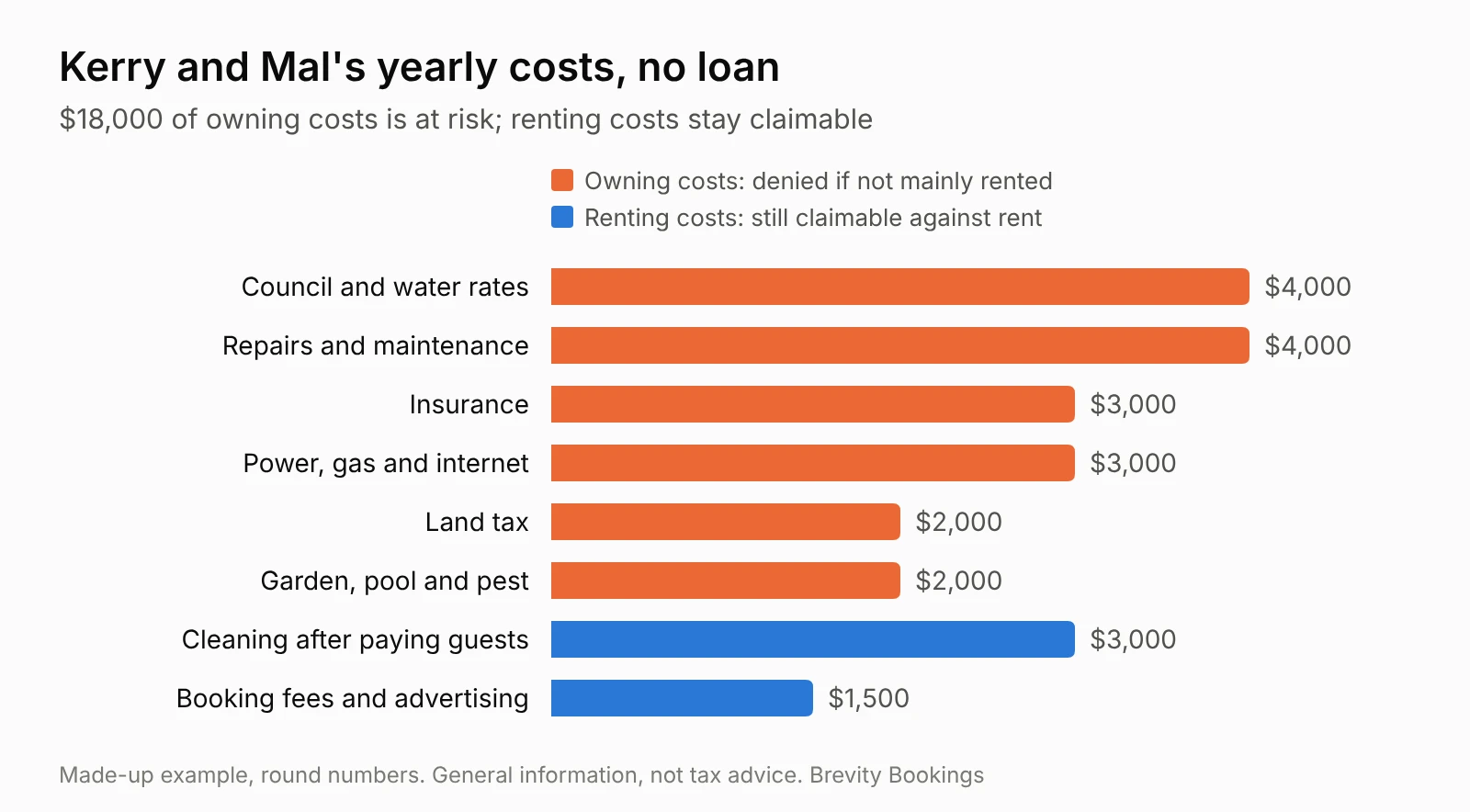
- costs of owning: council and water rates $4,000, repairs and maintenance $4,000, insurance $3,000, power, gas and internet $3,000, land tax $2,000, garden, pool and pest control $2,000, so $18,000
- costs of renting: $1,500 a year in booking fees (what a platform or agent charges to take a booking) and advertising for other guests, plus $250 for a clean after each week-long stay
The kids and grandkids want the house for seven peak weeks: the Christmas school holidays and Easter. Off-peak, the house is rented to other guests for 12 weeks.
Scenario A: the family stays free
The family gets its seven peak weeks free. With the peak periods blocked out, this looks like the ATO's Carla example: a holiday home not mainly rented, so the $18,000 of owning costs is denied.
- rent from other guests: 12 weeks at $1,250, so $15,000
- renting costs, deductible: $1,500 in booking fees and advertising plus $3,000 for 12 cleans, so $4,500
- owning costs: $18,000, not deductible
- cleaning after the family's stays: $1,750, not deductible
- net rental income: $10,500, or $5,250 each
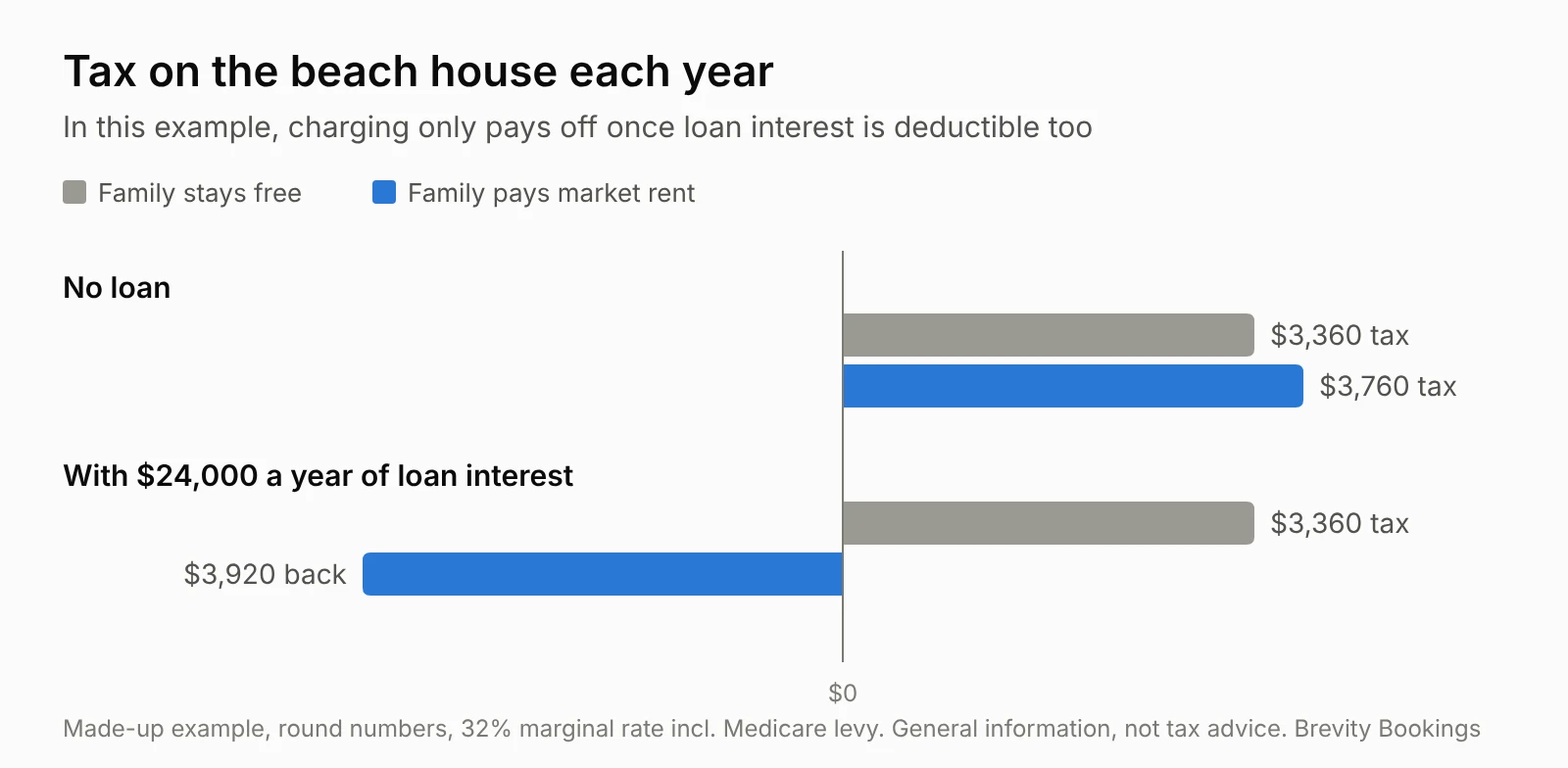
- tax at 32%: about $3,360 between them
So the beach house costs them money and the ATO still wants its slice.
Scenario B: the family pays market rent
Now the family pays the full peak rate for its seven weeks, and the house is properly advertised and available on commercial terms for the rest of the year. Assume (and it's a real assumption) the ATO accepts the house is mainly rented, so the owning costs are deductible. What the ATO looks for is under "What has to be true for Scenario B to work?" below.
- rent: $21,000 from family (7 weeks at $3,000) plus $15,000 from other guests, so $36,000
- renting costs, deductible: $1,500 in booking fees and advertising plus $4,750 for 19 cleans, treating the family as paying guests now, so $6,250
- owning costs: $18,000, now deductible
- net rental income: $11,750, or $5,875 each
- tax at 32%: about $3,760 between them
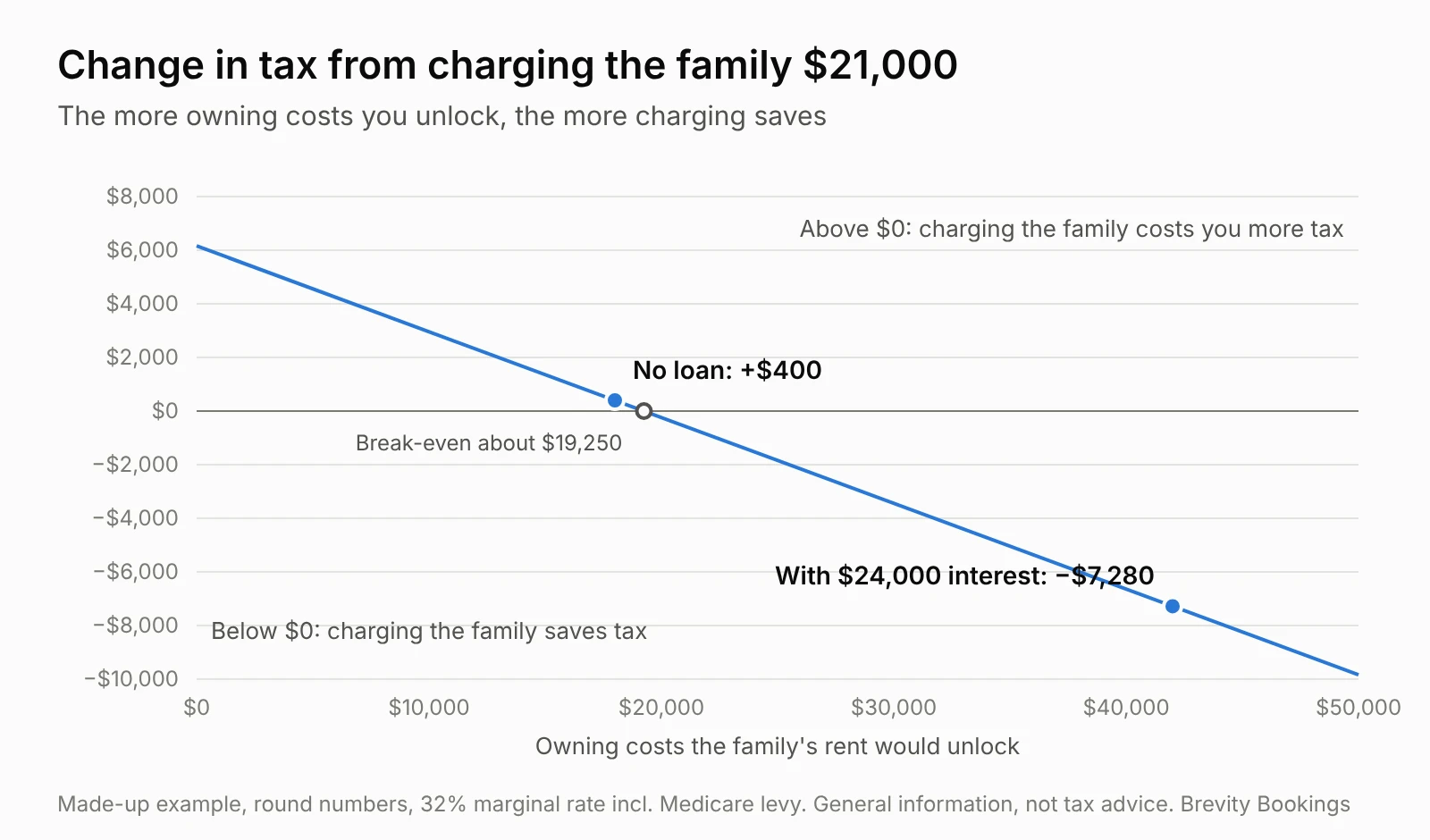
That's about $400 more tax than Scenario A. The $18,000 of owning costs saves about $5,760 in tax, but the family's $21,000 of rent, less the $1,750 of cleaning that becomes deductible, adds about $6,160. Kerry and Mal are better off, the grandkids are $21,000 worse off, and the tax office ends up $400 ahead. Someone still has to tell the grandkids they're now paying guests.
What if there's a loan?
Give Kerry and Mal a loan with $24,000 a year of interest and the picture flips. In Scenario A, the interest is denied along with everything else, so their tax stays at about $3,360. In Scenario B, the interest is deductible too. Their deductions come to $48,250 against $36,000 of rent, a loss of $12,250. That loss comes off their salary income (the ATO's page on how to claim rental expenses says rental deductions can be claimed against other income), which gets them about $3,920 back.
That's a swing of about $7,280 a year in tax in favour of charging the family.
One more thing to check with your tax agent. The law now limits negative gearing on residential property to new builds from 1 July 2027, and property held at 7:30pm AEST on 12 May 2026 is exempt (see the ATO's page on the negative gearing and CGT reforms). So the ATO says a place you already held then is exempt from the change, and a loss like that one would still come off your salary. Confirm with your tax agent that yours qualifies. If you're buying a beach house now, don't count on it.
What decides it?
The rough rule from the sums: charging the family changes your tax by your marginal rate times (the family's rent, minus the cleaning after their stays that becomes deductible, minus the owning costs you unlock).
For Kerry and Mal, the family's rent less its cleaning is $19,250. Unlock more owning costs than that (the running bills, like rates, insurance and interest, not improvements) and charging saves tax. Unlock less and it costs tax.
So it tends to pay off when:
- the owning costs you'd get back are bigger than the rent the family would pay, which usually means a sizeable loan
- your marginal tax rate is high, because each deduction is worth more
And it tends not to when:
- the house is paid off and the bills are modest
- your taxable income is low, for example in retirement, so deductions are worth little and losses may just carry forward to later years
- the family wouldn't, or couldn't, pay a genuine market rate
What has to be true for Scenario B to work?
This is where the sums meet the fine print. The ATO weighs how the house is actually used, how much time it earns rent, and whether it's available and rented over peak periods (TR 2026/1, paragraph 41). No single factor decides it, and advertising the place while you're not using it isn't enough on its own (paragraphs 40, 42 and 111).
The ATO's compliance guideline on this exact question, PCG 2026/3, has no safe harbour and no magic number of nights. It looks at the whole ownership period, and no single factor decides it (paragraphs 20 and 21). It sorts arrangements into green, amber and red zones. Amber sits in the middle, and includes increased personal use by you and friends, free or below market rates (Table 1); part 3 covers that. The two ends:
- Green (low risk): high paying occupancy, especially over popular holiday and peak periods, little or no personal use, rent put ahead of other uses, commercial terms and real effort to fill the place (PCG 2026/3, paragraph 23 and Table 1). If you're in the green zone, the ATO won't apply compliance resources beyond confirming that (paragraph 7).
- Red: blocking out times every year for personal use, especially popular periods, and pricing above market rates. The ATO's Josh example, a beach house kept for family at Christmas, Easter and the summer school holidays and rented to others about 10 weeks a year, is red and loses its ownership deductions (PCG 2026/3, Example 9). That's Scenario A.
Once a house is mainly rented, the apportionment guideline PCG 2026/2 adds some useful pointers:
- When family or friends pay market rent, no apportionment is needed, but you need to be able to show how you worked out the market rate, for example with a rental valuation or comparable listings at the time (PCG 2026/2, paragraphs 47 and 48).
- Days the house sits empty only count as held for rent if it's available on commercial terms. Signs of that include broad advertising and rental terms similar to comparable places (PCG 2026/2, paragraphs 15 and 16).
- Signs it isn't available include word-of-mouth-only advertising, blocking it out for private use when it would likely be rented, above-market rent and unexplained refusals (PCG 2026/2, paragraph 17).
None of the three documents says in so many words that family paying market rent over Christmas passes the "mainly" test. PCG 2026/3 doesn't deal with family at market rent at all. Market rent with good evidence is the strongest version of the argument, not a guarantee. And the money has to be real. Rent the family pays and quietly gets back isn't rent, and TR 2026/1 points to an anti-avoidance rule, section 26-50(7), for schemes designed to get around the holiday home rule (paragraph 44).
Is there a consolation prize in Scenario A?
Possibly. TR 2026/1 says denied ownership costs may form part of the property's cost base for capital gains tax (paragraph 95), which could reduce the gain when you sell. Whether they do depends on the cost base rules and your situation, so keep every receipt and ask your tax agent.
And there's the part no spreadsheet captures: the family gets Christmas at the beach without an invoice.
How Brevity Bookings helps
Brevity Bookings gives your holiday home its own booking calendar, where family, friends and repeat guests ask to stay and you approve who books. Guests sit in groups you set up, and each group either pays, at the rates you set, or stays free.
Each paying booking, cleaning job and maintenance cost flows into an income and expense ledger that follows the Australian financial year. The Finances section has a usage log that tags every night as rented, private, blocked or available, and the year's export for your accountant includes those counts. A paid stay shows as rented whatever you charged, so the ledger is where the actual rent lives. It's bookkeeping, not a tax ruling.
What it costs is on the pricing page. If some of your stays come through the big booking platforms, the fee calculator compares what they charge.
Common questions
Do I have to charge my family market rent?
No. Nothing in TR 2026/1 makes you charge family anything. If they stay free or at mates' rates, that's private use, and if it means the house isn't mainly rented, the ownership deductions go.
Can I pay rent to myself to keep the deductions?
No. The ruling describes rental property as property you provide to others in return for rent (TR 2026/1, paragraph 12). Money moving from your left pocket to your right pocket isn't rent.
If the family pays market rent, is the house definitely mainly rented?
Not definitely. The ATO looks at the whole year's pattern of use and availability. Family paying market rent helps, but the rest of the year matters too.
Does the family's rent get taxed?
Yes. Rent the family pays is assessable income for the owners, whether it's market rent or mates' rates (TR 2026/1, paragraph 67).
Where to from here
- Put your own numbers into the rule of thumb above: the family's rent against the owning costs you'd unlock.
- Read part 3, mates' rates at the holiday home, for what happens when the family pays something but not the going rate.
- Take your numbers to a registered tax agent before you send the family an invoice.
References
- ATO, Taxation Ruling TR 2026/1 Income tax: rental property income and deductions for individuals who are not in business, issued 20 May 2026
- ATO, Practical Compliance Guideline PCG 2026/3 Application of section 26-50 of the Income Tax Assessment Act 1997 to holiday homes that you also rent out - ATO compliance approach
- ATO, Practical Compliance Guideline PCG 2026/2 Apportionment of rental property deductions - ATO compliance approach
- ATO, Holiday homes
- ATO, Keeping records for property
- ATO, Tax rates – Australian resident
- ATO, How to claim rental expenses
- ATO, Tax reform – Boosting home ownership – Reforming negative gearing and capital gains tax
General information only, not tax advice. Check your own situation with a registered tax agent.