Mates' rates at the holiday home: what they cost you at tax time
General information only, not tax advice, and it doesn't take your circumstances into account. It reflects ATO guidance as at November 2026. For advice on your situation, talk to a registered tax agent (check one on the Tax Practitioners Board register) or contact the ATO.
Short answer: mates' rates can land you with the worst of both worlds. The discounted rent is still taxable income. And if family and friends at a discount are most of the house's use, the ATO is likely to treat it as a holiday home that isn't mainly rented, so you lose deductions for interest, rates and repairs as well.
This is part 3 of a three-part series. Part 1 explains the TR 2026/1 rule, and part 2 runs the numbers on charging the family market rent.
The thread running through all three parts: keep good records and let a registered tax agent make the call. Brevity Bookings keeps the record of who stayed and what they paid as you go. More on that near the end.
That doesn't make mates' rates wrong. Plenty of families would rather the cousins had the house cheap than chase every dollar of deduction. Just go in knowing the price.
Does this apply to me?
Pull up a chair if:
- you own a holiday house as an individual, not through a company or trust
- most of the people who stay are family and friends
- some of them pay something, but not the going rate
Call a registered tax agent early if:
- the house is owned through a company or trust, or renting it is part of a business
- you charge family a "contribution" and aren't sure whether it's rent
- you have a loan on the house, because that's where most of the deductions are
Is rent from family taxable if it's below market?
Yes. TR 2026/1 says amounts from family and friends, while not at arm's length, are still rent or licence fees and go in your assessable income (paragraph 67). In the ATO's Arnaud example, a below-market rent from his brother is still ordinary income, and Arnaud has to apportion his deductions (paragraph 68).
There's a narrow exception. An amount that is only a contribution towards the upkeep of someone you're responsible for caring for isn't assessable, but only if it has no relationship to the use of your property, and you need to be able to show that (TR 2026/1, paragraph 66). "They chipped in for the power while they were there" relates to their stay, so don't count on it.
Why do mates' rates put the deductions at risk?
Because of how the ATO defines a holiday home. It's a property used, or held for use, for your holidays, or for holidays of your family and friends for no rent or at a reduced rate (TR 2026/1, paragraph 12). Discounted stays sit on the private side of the ledger, not the rental side.
There's no approved discount, either. The definition just says "a reduced rate", and neither TR 2026/1 nor the ATO's holiday homes page puts a number on it. Ask your tax agent before relying on a discount that feels reasonable.
If a holiday home isn't used or held mainly to earn rent at all times during the income year, ownership costs such as interest, council rates, land tax and repairs are denied (TR 2026/1, paragraphs 35, 37 and 94). In the ATO's Carla example, the family has the house over the peak periods and it's rented only about five days a year, so the ownership costs go. The ATO adds that the tax outcome is similar if she lets friends stay rent-free or below market rent (paragraphs 119 to 121).
The ATO's compliance guideline, PCG 2026/3, sorts arrangements into green, amber and red zones. It lists personal use by you or friends for free or below market rent as an amber-zone factor, and blocking out peak periods every year as red (Table 1).
So if your bookings are mostly family and friends at a discount, expect the ATO to see a family holiday house that also earns a bit of rent. Not a rental that the family occasionally borrows.
What does it cost, roughly?
Take the made-up couple from part 2, Kerry and Mal. They own the house outright, half each, and pay 32 cents in the dollar including the Medicare levy. Off-peak they rent it to other guests for 12 weeks at $1,250, which is $15,000. Renting costs are $1,500 a year in booking fees and advertising, plus $250 for a clean after each week-long stay. The house carries $18,000 a year of owning costs, such as rates, insurance and repairs.
This time the family pays mates' rates, $1,500 a week instead of the $3,000 market rate, for its seven peak weeks.
- rent: $15,000 from other guests plus $10,500 from family, so $25,500
- renting costs, deductible: $1,500 in fees plus $4,750 for 19 cleans, so $6,250
- owning costs: $18,000, not deductible, because the house isn't mainly rented
- net rental income: $19,250
- tax at 32%: about $6,160 between them
That's around $2,800 more tax than letting the family stay free (part 2's Scenario A, about $3,360), with the same lost deductions. The family's $10,500 goes in, $1,750 of cleaning comes off, the rest is taxed at 32 cents in the dollar, and nothing gets unlocked in return. Free would have been cheaper for everyone except the tax office.
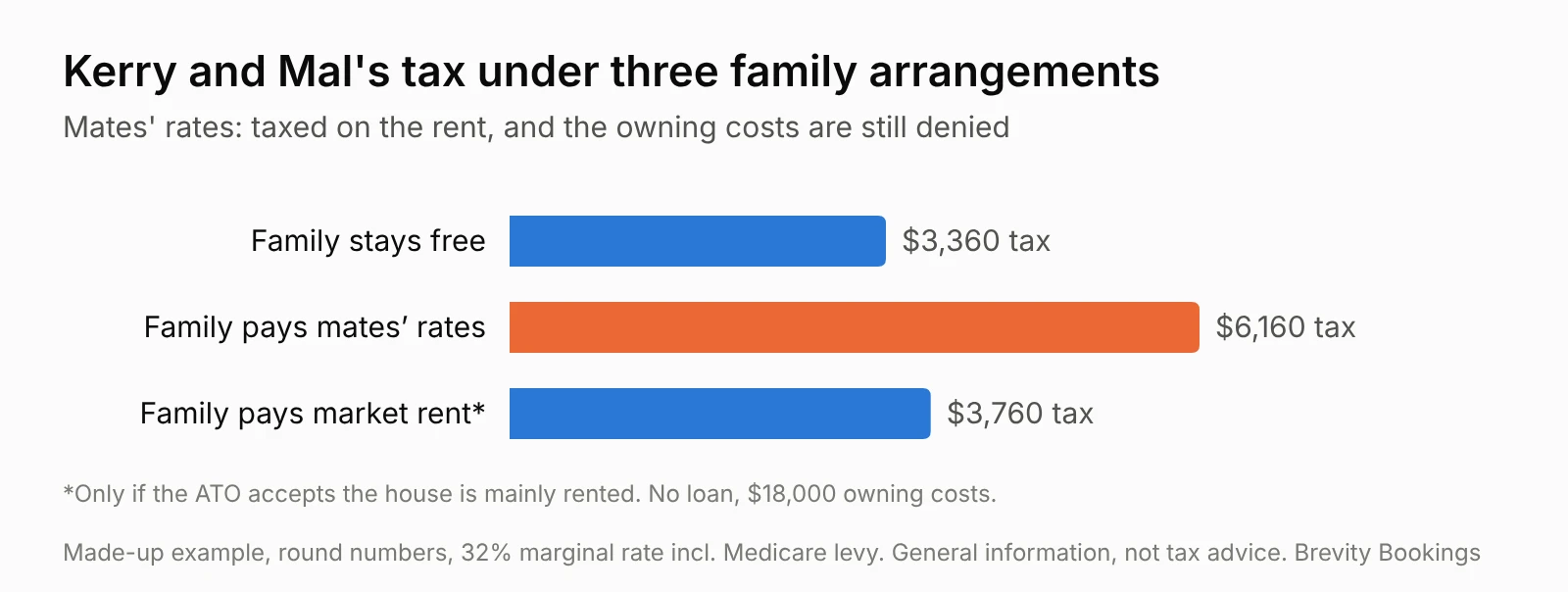
We've assumed the cleaning after the family's discounted weeks is claimable against their rent. If it isn't, the gap is closer to $3,400 than $2,800. These are round numbers for one made-up couple. Your costs, tax rate and rents will change the answer.
What if the house is mainly rented and family stay now and then?
Then the ownership costs aren't blocked by the holiday home rule, but you still apportion. In the ATO's Eve example, she uses her apartment for a night or two a year, off-peak, and doesn't reserve it for herself. It's still mainly rented, but she has to apportion her deductions for those nights (TR 2026/1, paragraphs 116 to 118).
The ATO's apportionment guideline, PCG 2026/2, covers family and friends directly:
- Family or friends at market rent: no apportionment needed, as long as you can show how you set the market rate, for example with a rental valuation or comparable listings at the time (PCG 2026/2, paragraphs 47 to 49).
- Family or friends below market rent: the ATO accepts limiting the deductions to the rent you receive, so the arrangement makes no net rental income or loss (PCG 2026/2, paragraph 44). In its Jana example, she rents to her mother below market rent, and her deductions are limited to the rent she receives (paragraph 45).
PCG 2026/2 doesn't cover deductions the holiday home rule denies. It only applies once the house is mainly rented and you're apportioning for private use (paragraph 6).
Does word of mouth count as available for rent?
Not on its own. Under PCG 2026/2, days the house sits empty only count as held to earn rent if it's available on commercial terms. Signs that it isn't include advertising only by word of mouth, blocking it out for private use when it would likely be rented, above-market rent, not keeping an eye on booking requests, and turning people down without a good reason (paragraph 17).
The ATO's Daniel and Kate example shows how that plays out. Their cottage, which they live in for work and don't holiday in, is rented for 14 days through word of mouth, and the empty days aren't treated as held for rent, so only 14/365 of their expenses are deductible (PCG 2026/2, paragraphs 18 to 20). TR 2026/1 has a different Daniel and Kate (same names, different house): theirs is a holiday home, rented 10 to 14 days a year with the school holidays blocked out, and the ownership costs are denied outright (paragraphs 122 to 126). The family group chat is a fine booking system, but it isn't advertising.
What about emailing next year's rates to past guests? The guideline doesn't mention it. It counts advertising that gives the house "broad exposure to potential tenants" as a sign it's available (PCG 2026/2, paragraph 16), and advertising "in ways that limit its exposure" as a sign it isn't (paragraph 17). An email only to people you already know looks like the second kind, so check with your tax agent before counting the empty days.
What records should you keep?
The ATO expects you to be able to objectively explain why your own and your family's use doesn't detract from the rental use (TR 2026/1, paragraph 113). Your memory of last Christmas won't cut it, especially after a few drinks on the deck. Keep:
- who stayed each night, and what they paid, if anything
- how you set the rent, including any rental valuation or comparable listings for family at market rent
- where and when you advertised, and when the house was available over the peak periods
- booking requests, and why you turned any down
- every expense, and whether it relates to owning the place or to renting it
How Brevity Bookings helps
Brevity Bookings gives your holiday home its own booking calendar. Family, friends and repeat guests ask to stay and you approve who books, so the record of who stayed lives in one place instead of a group chat. Guests sit in groups you set up, and each group either pays, at the rates you set, or stays free.
Each paying booking, cleaning job and maintenance cost flows into an income and expense ledger that follows the Australian financial year. The Finances section has a usage log that tags every night as rented, private, blocked or available, and the year's export for your accountant includes those counts. A free stay shows as private. A paid stay shows as rented whatever you charged, so a mates'-rates stay counts as rented there and the ledger shows the actual rent. It's bookkeeping, not a tax ruling.
What it costs is on the pricing page. If some of your stays come through the big booking platforms, the fee calculator compares what they charge.
Common questions
Do I have to declare rent my family pays me?
Yes. It's assessable income even when it's below market rent (TR 2026/1, paragraph 67).
Is it better to let family stay free than charge mates' rates?
In tax terms, often yes, if the house is a holiday home that isn't mainly rented. You lose the ownership deductions either way, and only the mates' rates get taxed. The numbers above show how it plays out.
Can I still claim anything if the house isn't mainly rented?
Yes. Costs that relate only to renting, such as advertising, booking fees and cleaning after guests, are deductible to the extent they're incurred to earn rent (TR 2026/1, paragraph 36). Cleaning after your own or your family's stays isn't.
What if family pay the full market rate?
Then PCG 2026/2 says no apportionment is needed, provided you can show how you set the rate (paragraphs 47 to 49). Whether the house is mainly rented still depends on the whole year.
Where to from here
- Look at last year's calendar and count who stayed, when, and for how much.
- Decide on purpose whether family pay nothing, mates' rates or market rent, knowing what each costs.
- Keep this year's record as you go, in Brevity Bookings or a diary, not from memory in July.
- Take that list to a registered tax agent before you lodge your 2026-27 return.
References
- ATO, Taxation Ruling TR 2026/1 Income tax: rental property income and deductions for individuals who are not in business, issued 20 May 2026
- ATO, Practical Compliance Guideline PCG 2026/3 Application of section 26-50 of the Income Tax Assessment Act 1997 to holiday homes that you also rent out - ATO compliance approach
- ATO, Practical Compliance Guideline PCG 2026/2 Apportionment of rental property deductions - ATO compliance approach
- ATO, Holiday homes
- ATO, Tax rates – Australian resident
General information only, not tax advice. Check your own situation with a registered tax agent.